
SUBMIT YOUR DETAILS FOR
The Magic of the California Sun
Imagine waking up to the soft, golden glow of a Pacific sunrise filtering through a floor-to-ceiling glass wall. There is no hard line where your living room ends and your garden begins. The air smells of salt and eucalyptus, and the transition from your morning coffee on the sofa to your meditation on the deck is seamless. This isn’t just a dream; it is the essence of the contemporary California residential style.
For decades, California has been the epicenter of architectural iovation. From the Mid-Century Modern masterpieces of Palm Springs to the tech-integrated smart homes of Silicon Valley, the Golden State has redefined what it means to live “at home.” Today, contemporary California style is more than just a look—it is a philosophy of living that prioritizes light, landscape, and a relaxed, yet sophisticated, lifestyle.
The Evolution of the California Aesthetic
To understand where we are today, we have to look back at the roots. California architecture was born out of a desire to break free from the dark, compartmentalized Victorian homes of the East Coast. Architects like Richard Neutra and Frank Lloyd Wright saw the California climate as an opportunity to experiment with open floor plans and organic materials.
In the modern era, this has evolved into a style that feels curated yet lived-in. We are moving away from the “cold” minimalism of the early 2000s and toward something designers call “Warm Modernism.” It is about clean lines and sharp angles, yes, but it is also about the texture of reclaimed wood, the softness of linen, and the vibrant greens of drought-tolerant landscaping.
Style 1: The Modern Farmhouse Reimagined
If you have driven through the hills of Napa or the suburbs of Los Angeles lately, you’ve likely seen the evolution of the Modern Farmhouse. While it started as a trend popularized by television designers, California has put its own unique spin on it. The California Modern Farmhouse is characterized by:
- High Contrast: Bright white board-and-batten siding paired with sleek black steel window frames.
- Natural Accents: Light-toned wood, such as white oak, used for flooring and exposed ceiling beams to add warmth.
- Industrial Touches: Metal light fixtures and sliding barn doors that feel more like modern art than rustic farm tools.
What makes this style uniquely “contemporary” is the scale. These homes often feature massive “Great Rooms” where the kitchen, dining area, and living space all flow into one another, centered around a fireplace that acts as the home’s heart.
Style 2: Desert Modernism and the Palm Springs Vibe
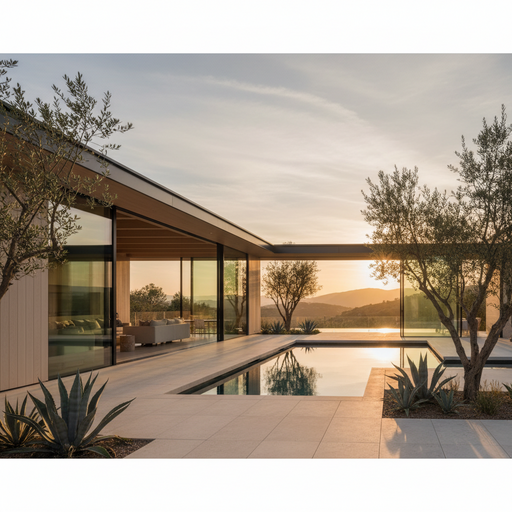
Moving south into the Coachella Valley, we find the iconic Desert Modernism. This style is built for the heat and the view. It’s about being low-slung and horizontal, mimicking the flat horizons of the desert floor. Today’s interpretation of this style involves:
- Stacked Stone: Using local stone for exterior walls to make the house feel like it grew out of the earth.
- Deep Overhangs: Large roof eaves that provide essential shade while creating dramatic shadows.
- Xeriscaping: Landscaping that uses cacti, succulents, and decomposed granite instead of thirsty green lawns, reflecting California’s commitment to water conservation.
In these homes, the “backyard” is usually an extension of the living room, often featuring an infinity-edge pool that reflects the vast California sky.
Style 3: Coastal Contemporary
Along the coast—from Malibu to Laguna Beach—the style takes a different turn. Coastal Contemporary is all about the “Blue and the Gray.” It draws inspiration from the ocean and the mist. You won’t find the kitschy anchors or nautical themes of the past here. Instead, you’ll find:
Refined materials like glass, concrete, and weathered wood dominate the scene. The goal is to maximize the view. Multi-slide glass doors that disappear into “pockets” in the wall are a staple, turning the entire house into an open-air pavilion. The color palette is muted—think sandy beiges, misty grays, and soft creams—allowing the blue of the Pacific Ocean to be the primary color in the room.
Key Features of a Contemporary California Home
Regardless of the specific sub-style, there are several “non-negotiable” elements that define the modern California residential experience:
1. Indoor-Outdoor Flow
This is the holy grail of California design. The goal is to eliminate the psychological barrier between inside and outside. This is achieved through large glass doors, continuous flooring materials that run from the kitchen out to the patio, and outdoor “rooms” equipped with kitchens, fireplaces, and even televisions.
2. Natural Light as a Building Material
In California, light is treated as a material just as important as wood or stone. Architects use clerestory windows (high, narrow windows near the roofline) to let in light while maintaining privacy. Skylights and light wells are also common, ensuring that even the center of a large home feels bright and airy.
3. Sustainable and Smart Integration
Modern California homes are among the most technologically advanced in the world. This includes “invisible” tech like built-in solar panels, Tesla Powerwalls for energy storage, and smart home systems that control everything from the irrigation to the window shades. Sustainability isn’t just a buzzword; with strict building codes like Title 24, it’s a way of life. Using recycled materials and low-VOC paints is the standard, not the exception.
The Heart of the Home: The California Kitchen
In a contemporary California home, the kitchen is no longer a hidden room for food preparation. It is the social hub. We are seeing a trend toward “The Hidden Kitchen” or “The Minimalist Kitchen.” Appliances are often integrated with cabinetry panels so they disappear. Islands are massive, often topped with a single slab of quartzite or marble, serving as both a prep station and a social bar.
Another rising trend is the “Prep Pantry” or “Scullery.” This is a secondary kitchen behind the main one where the messy work happens, leaving the main kitchen pristine for entertaining—a perfect setup for the California lifestyle of hosting dier parties and wine tastings.
Landscaping: The Final Layer
The contemporary California style doesn’t stop at the walls. The landscaping is an integral part of the architecture. Gone are the days of the English rose garden in the middle of a Los Angeles suburb. Today, it’s about “Wild Modernism.” This involves planting native grasses that sway in the wind, architectural agaves, and olive trees that provide a Mediterranean feel. Lighting is used subtly to highlight the silhouettes of these plants at night, turning the garden into a living art gallery.
Conclusion: Living the Dream
Contemporary California residential style is more than a set of blueprints; it is a response to the environment and a celebration of a relaxed way of life. It’s about stripping away the uecessary and focusing on what truly matters: light, space, and a coection to the world around us. Whether it’s a compact modern bungalow in Venice Beach or a sprawling estate in the Santa Barbara hills, the core remains the same—a home that breathes with the landscape and provides a sanctuary from the busy world outside.
If you’re looking to bring a piece of California into your own life, start with the light. Open up your spaces, bring iatural textures, and never underestimate the power of a single, well-placed glass door. After all, the Golden State isn’t just a place on a map—it’s a state of mind.


